
The project at a glance
ClassicOutlook-Toolkit is a toolbox for Outlook Classic that makes it easier to file emails, track replies and prepare personalised mailings. It also brings together contact management, calendar and email analytics features. Written in VBA, it runs inside Outlook, with no additional software to install.
It is aimed in particular at people who receive hundreds of emails a month and follow dozens of projects, clients or partners at the same time. The goal: improve your working environment and save time on sorting, replying and managing your mailbox.
In numbers: around sixty modules, about 47,000 lines of code, more than 60 commands available from the ribbon. It is probably one of the most extensive open-source VBA projects for Outlook.
Before you start: the toolkit requires Outlook Classic for Windows (not the New Outlook, nor Outlook on the web or for Mac), 64-bit Office and permission to run macros. Several features rely on Excel. Initial setup takes about an hour, with the guide at hand. The interface is available in English and French.
Contents
- Why I built this tool
- 1. File emails automatically, without browsing the folder tree
- 2. Track replies and know who to follow up
- 3. Prepare truly personalised email campaigns
- 4. Maintain your contacts, in the spirit of a light CRM
- 5. Link meetings to projects and time tracking
- 6. Measure your email workload
- 7. The small commands that make the day easier
- 8. Under the hood
- 9. Set up and try the toolkit
- 10. An open, documented and evolving project
Why I built this tool
When you follow many projects, every email triggers small actions: finding the right folder, filing your reply, checking whether someone has answered, preparing a follow-up, linking a meeting to a project. Taken one by one, these operations are quick. Repeated all week long, they end up taking a significant share of the day.
I built ClassicOutlook-Toolkit from these needs, over eight months, with the help of an AI assistant and without being a professional developer. The constraint: stay within the Outlook environment available on my workstation, without administrator rights or additional software. The VBA built into Outlook made it possible to assemble this set of tools step by step. Without AI, the same work would probably have taken a developer close to a year.
The filing and pending-reply detection features rely on configurable rules. They do not need an AI assistant to work. A separate module lets you, if you wish, send a text to a writing assistant in the browser.
1. File emails automatically, without browsing the folder tree
QuickMove is the heart of the toolkit. It reads the selected email, looks for a project or contract code in the subject, then in the attachment names, then in the body, and moves the email straight away when a single folder matches. Otherwise, a few characters are enough to pick the destination. Emails that already carry a project or contract reference get filed almost without thinking about it.
| Tool | What it does |
|---|---|
| QuickMove | Detects the project or contract code; files directly when a single folder matches, searches otherwise. Every accessible mailbox is indexed. A missing folder can be created from the project reference list. |
| Reply filing | The reply sent to an already filed email joins the original folder, including in a shared mailbox. Both sides of the exchange stay together. |
| Go to folder | Jump to any folder by keyword, without expanding the folder tree. |
| Folder tools | Archive inactive folders, merge duplicates, sort the tree, rename in bulk after review, export emails to PDF. |

2. Track replies and know who to follow up
A sent email is not a closed matter: a proposal, a request for approval or a question to a partner may wait several days for an answer. The toolkit keeps track of these exchanges and flags the delays.
| Tool | What it does |
|---|---|
| Reply tracking | Excel dashboard: tracked messages, detected replies, elapsed time. Delays highlighted in colour, built-in follow-up commands. |
| Pending-reply detection | After sending, configurable words and phrasings flag a message that seems to expect an answer and offer to track it. A spotting aid: the decision to track remains yours, and not every email belongs in the dashboard. |
| Snooze | A snoozed email comes back to the inbox on the chosen date. |
3. Prepare truly personalised email campaigns
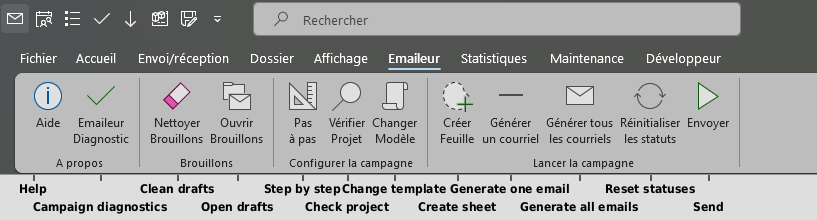
A mail merge from Excel where each row is a message in its own right: enough to send documents to several partners, prepare introductions or send invitations that need more than a change of first name.
| Tool | What it does |
|---|---|
| One row, one message | Recipients, Cc, Bcc, subject, body, attachments and Outlook template specific to each row. A message in French for one person, in English for another: the language is that of the prepared text, not an automatic translation. |
| Review before sending | Display the message of one row to check it, or generate all the drafts. The Outlook template keeps the layout and signature. |
| Paced sending | In batches, in the background, row-by-row status, stop at any time. Outlook remains usable during the campaign. |
4. Maintain your contacts, in the spirit of a light CRM
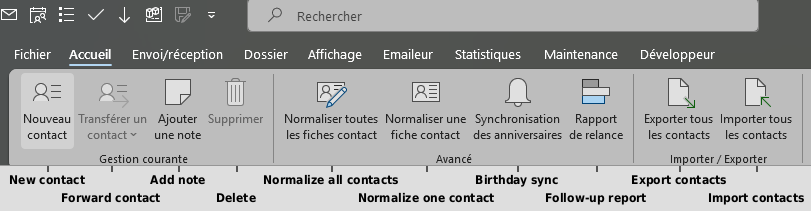
The address book becomes a relationship-tracking tool: clean details, a record of exchanges, contacts to get back in touch with. A personal follow-up inside Outlook, which does not claim to replace a shared sales CRM.
| Tool | What it does |
|---|---|
| Card from a signature | A card pre-filled from the selected email: name, job title, organisation, phone numbers, address. To be checked and completed. |
| Log per person | A dated note added at the top of the card, in one click. |
| Cooling relationships | A report of contacts with no exchange for a long time, built from sent emails. |
| Harmonisation | Name capitalisation, phone number formats, addresses, duplicates. |
| Birthdays | A birthday and name-day calendar synchronised with the cards, with reminders. |
| Import / export | Backup and re-import of the address book as CSV, photos included. |
5. Link meetings to projects and time tracking
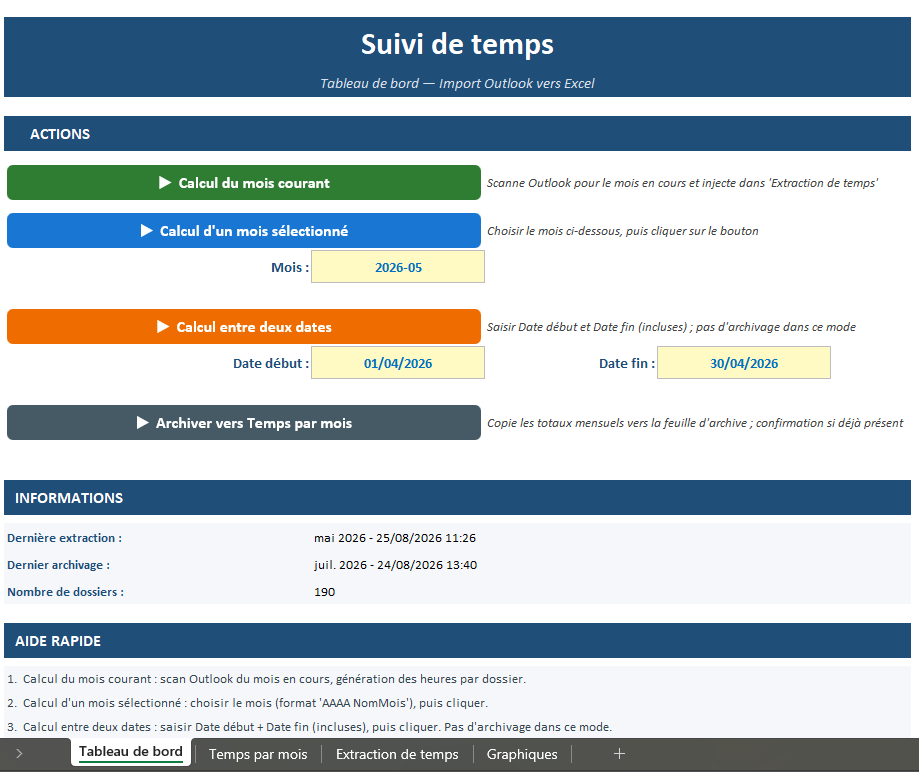
Each appointment can be attached to a project; the calendar then feeds a time-tracking sheet in Excel, and the week can be read at a glance thanks to colours.
| Tool | What it does |
|---|---|
| Project tagging | When an appointment is created, a project link is suggested; the title receives the project code and name. |
| Automatic colouring | Meetings coloured by type: internal, external, sales. |
| Anti-overlap | Some short appointments are shifted automatically when they collide. |
| Meeting without guests | A meeting saved with no participant other than you becomes a simple appointment again, Teams block removed. |
| Convenience | One-click “flash” slot, 15-minute default duration, ± 15-minute shift, private appointments for certain organisers, two windows with fixed roles (mail / calendar). |
6. Measure your email workload
A standalone Excel tool, separate from the Outlook toolkit and from time tracking, analyses the accessible mailboxes and produces a full report. A way to put figures on a workload that is often hard to assess: how the volume evolves, when exchanges concentrate, what share arrives in copy.
| Tool | What it does |
|---|---|
| Volumes | Sent and received, internal and external share, split between main recipient and copy. |
| Rhythms | Days and hours of activity, monthly and yearly trends. |
| Relationships | Main contacts, response times. |
| Incremental update | Only new messages are analysed; no full rescan each time. |
7. The small commands that make the day easier
| Tool | What it does |
|---|---|
| Greeting line | Personalised greeting in replies to a single person, not repeated if you have already written to them that day. First name taken from the company directory when available. |
| Alerts per mailbox | One notification per mailbox, configurable sound and colour, grouped in case of a burst, silent when Outlook is already in the foreground. |
| Quick searches | Received this week, sent this week, in one button. |
| Mark all as read | After counting and confirming, default mailbox and subfolders included. The previous state is not kept. |
| Banners and prefixes | Confidentiality or urgency flagged in the body and the subject, Outlook sensitivity synchronised. A visual cue, not encryption. |
| Hidden Bcc field | Hidden on every new message, to avoid blind copies sent by mistake. |
| Bridge to an assistant | The text of a message being written sent to Claude, Mistral or ChatGPT in the browser, via the clipboard. Only for texts you are allowed to share. |
| Housekeeping | Periodic cleanup of technical flags, category management. |

8. Under the hood
A few infrastructure modules hold everything together and keep it maintainable.
| Tool | What it does |
|---|---|
| Central configuration | One text file, config.ini: language, workbook paths, project codes, colours, trigger words, options. The code itself stays generic. |
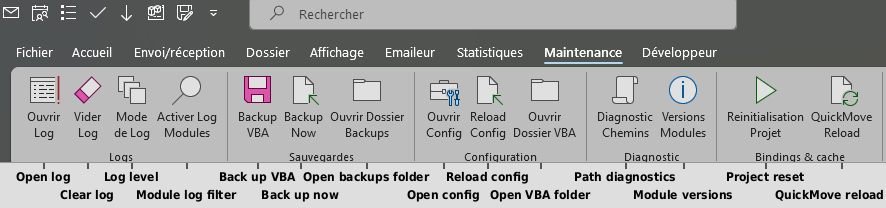
| Diagnostic log | Each module writes to a shared log with four levels of detail, to understand unexpected behaviour without a debugger. |
| Deferred actions | A small home-made scheduler, where Outlook cannot reliably run code “in ten seconds”. |
| Custom dialog boxes | Renamed buttons, automatic closing, guaranteed display in the foreground: without custom forms, which are forbidden in many environments. |
| Excel without surprises | Workbooks opened discreetly, ghost instances avoided, saves without hidden windows. |
| Automatic backups | Full VBA project and settings backed up every month, timestamped. |
| Source checker | A Python script checks the files before pasting: misplaced declarations, accents, duplicates, unknown configuration keys. It replaces neither compilation nor testing. |
9. Set up and try the toolkit
Setting up means pasting the modules into Outlook’s VBA editor, configuring the environment, compiling the project and restarting Outlook. On first launch without a configuration file, a wizard checks the environment and offers to create a minimal config.ini. The ribbon customisations provided wire the commands to buttons; the features that rely on Excel also need their workbooks. In a corporate environment, macro permissions depend on the organisation’s rules.
Browse the configuration settings
10. An open, documented and evolving project
The repository gathers the source code, the workbook templates, the ribbon customisations and the documentation: architecture, logs, backups, maintenance tools. What is new in version 3 and the history of changes are in the release notes.
Ideas under consideration: a weekly review of exchanges to follow up, a per-project view, checks before sending contractual documents. These are planned developments, not features already available. The OneNote experiments remain separate from the uses presented here.
The code is released under the GNU GPL v3 licence: anyone can use, study, modify and redistribute it, provided that derivative work stays under the same licence. The full text is in the repository.
Read the licence · Read the release notes
If you try it, your feedback on installation and on day-to-day use will help the project move forward. You can report a problem or suggest an improvement in the GitHub issues.